

8 Best Calendly Alternatives for Smarter Scheduling
Calendly popularized scheduling links and made it easy to share your availability without endless back-and-forth emails.
For many professionals, it’s still the default scheduling tool. But as teams grow and workflows become more complex, Calendly’s booking-link model can start to feel limiting.
A simple scheduling page works well when meetings are straightforward. But when scheduling involves multiple participants, changing availability, or different communication channels, many teams begin looking for something more flexible.
That’s why more companies are exploring Calendly alternatives — tools that offer AI scheduling, better team coordination, or more natural ways to book meetings.
Below are some of the best Calendly alternatives available today.
Best Calendly Alternatives at a Glance
| Tool | Best For | Key Advantage |
|---|---|---|
| Skej | AI scheduling automation | Schedules meetings through email, Slack, WhatsApp, and SMS |
| SavvyCal | Personalized booking pages | Calendar overlay helps find mutual availability |
| Reclaim.ai | Time management | Automatically schedules tasks and protects focus time |
| Motion | Task + meeting management | AI automatically prioritizes tasks and meetings |
| OpenAssistant | General work | Highly customizable AI agents for any type of work & communication |
| Doodle | Group scheduling | Poll-based scheduling for multiple participants |
| HubSpot Scheduler | Sales teams | Integrated directly with HubSpot CRM |
| Chili Piper | Revenue teams | Instant lead routing and demo booking |
1. Skej

Skej is an AI scheduling assistant designed to automate the entire scheduling process instead of relying on booking links.
Instead of sending someone a link and asking them to pick a time, Skej works just like a human assistant inside your normal communications channels. You can simply add Skej to an email thread, Slack conversation, or message on WhatsApp or SMS, and the assistant will coordinate the meeting automatically.
Skej checks calendars, proposes times, follows up if someone doesn’t respond, and handles rescheduling when plans change. Because it works conversationally, scheduling feels much closer to having a human assistant managing your calendar.
Another advantage is flexibility. Skej can interpret natural language messages like “free Wednesday morning,” read screenshots of calendars, and even process someone else’s scheduling link to find mutual availability.
Best for: Teams that want AI-driven scheduling instead of booking links.
2. SavvyCal
SavvyCal is a modern scheduling tool designed as a more flexible alternative to traditional booking pages.
One of its standout features is the ability for recipients to overlay their own calendar while viewing your availability. This makes it easier to identify mutual free time without jumping between calendars.
SavvyCal also emphasizes personalization. Users can customize scheduling pages and messaging, creating a more polished experience when sharing links with clients or colleagues.
Best for: Professionals who want a more thoughtful booking page experience.
3. Reclaim.ai
Reclaim takes a different approach to scheduling by focusing on time management and calendar optimization.
Instead of primarily helping others book meetings with you, Reclaim automatically schedules tasks, habits, and focus time inside your calendar. It dynamically rearranges your schedule to protect deep work and avoid meeting overload.
This makes Reclaim particularly useful for individuals trying to regain control of their time.
Best for: Individuals who want automated time blocking and calendar optimization.
4. Motion
Motion combines scheduling with task and project management.
The platform automatically organizes tasks, deadlines, and meetings within your calendar. Motion’s AI prioritizes work based on urgency and dynamically adjusts your schedule when new tasks or meetings appear.
Because it blends scheduling with project management, Motion is often used by teams who want a unified system for managing both work and meetings.
Best for: Teams that want scheduling integrated with task management.
5. OpenAssistant
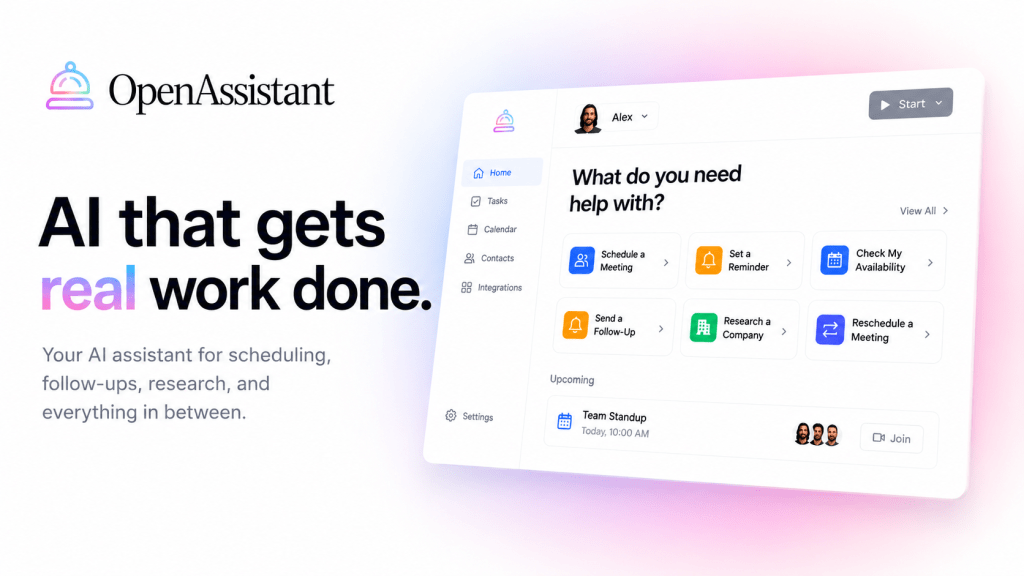
OpenAssistant is an AI assistant that handles scheduling alongside email, research, files, and other everyday work.
Instead of relying on booking links or requiring you to coordinate meetings manually, OpenAssistant can manage the scheduling process for you. It checks your calendar, communicates with participants, proposes available times, follows up when needed, handles rescheduling, and books meetings automatically.
Scheduling is just one of its capabilities. The same assistant can help manage your inbox, conduct research, prepare for meetings, work with files and documents, and complete tasks across connected applications. You can simply tell it what you need done and let it handle the work.
Key features include:
• AI-powered meeting coordination
• Automatic follow-ups and rescheduling
• Google and Outlook calendar support
• Email and inbox assistance
• Research and meeting preparation
• File and document creation and management
• Integrations with business tools and applications
OpenAssistant is a good fit for people who want the benefits of an AI scheduling assistant without using a tool dedicated only to scheduling. It combines meeting coordination with a broader AI assistant that can help get work done across your day.
Best for: Teams who need scheduling help and a broader assistant.
6. Doodle
Doodle remains one of the most widely used tools for coordinating meetings with large groups.
Instead of booking links, Doodle uses polls where participants vote on available meeting times. The organizer then selects the option that works best for everyone.
This approach works particularly well for organizing meetings across large teams or events.
Best for: Scheduling meetings with multiple participants.
7. HubSpot Meeting Scheduler
HubSpot offers a meeting scheduling tool built directly into its CRM platform.
Sales teams can embed scheduling links in emails, track meetings within the CRM, and automatically update contact records when meetings are booked.
For organizations already using HubSpot, this tool can replace standalone scheduling software.
Best for: Sales teams using the HubSpot ecosystem.
8. Chili Piper
Chili Piper is designed specifically for revenue teams and inbound lead scheduling.
Instead of waiting for prospects to schedule a meeting later, Chili Piper allows visitors to book demos immediately after submitting a form or requesting information.
This helps sales teams respond faster and increase lead conversion rates.
Best for: Sales organizations focused on inbound lead routing.
How to Choose the Right Calendly Alternative
The best Calendly alternative depends on how your team schedules meetings.
If your workflow revolves around booking links, tools like SavvyCal or HubSpot may offer the most familiar experience with added flexibility.
If your goal is improving time management and protecting focus time, Reclaim or Clockwise may be a better fit.
But if you want to eliminate the scheduling process entirely, an AI scheduling assistant like Skej can coordinate meetings automatically.
Instead of asking someone to choose a time from a link, the assistant simply finds a time that works for everyone.
The Future of Scheduling
Scheduling links were a major improvement when they first appeared. They reduced the need for back-and-forth emails and simplified meeting coordination.
But scheduling itself is evolving.
Instead of static booking pages, many teams are now adopting AI scheduling assistants that actively coordinate meetings.
These assistants don’t just show availability — they manage the entire scheduling process from start to finish.
Try a Smarter Calendly Alternative
If you're exploring Calendly alternatives, Skej offers a different approach to scheduling.
You can coordinate meetings through email, Slack, WhatsApp, or text without sending booking links or manually negotiating times.
Start a 7-day free trial and see what scheduling feels like when an AI assistant handles the logistics for you.
Make scheduling easier with Skej
Skej handles the back-and-forth while you focus on what's important.
Start Scheduling for FreeFree trial · No credit card required